UK Towing Safety Alliance Issues Maintenance Alert as Trailer Incidents Surge 37% on Strategic Road Network
They tell us…
Ageing vehicles, ageing trailers and the busy harvest season create a growing maintenance challenge for UK motorists
The UK Towing Safety Alliance (UKTSA) has today released a comprehensive four-year analysis of incident data (2022–2025) from National Highways’ Strategic Road Network (SRN). The findings reveal a critical 23% increase in total towing-related incidents, driven primarily by a growing maintenance crisis involving utility and commercial trailers.
While the data shows a welcome 17% reduction in traffic collisions involving towed vehicles—suggesting improvements in driver behaviour and awareness—the number of incidents caused by mechanical failure continues to rise. Breakdowns now account for 77% of all towing-related incidents, highlighting vehicle and trailer condition as the greatest challenge facing the sector.
The findings come as new SMMT Motorparc 2025 data reveals that Britain’s vehicle fleet is older than ever before. A record 45.7% of all cars on UK roads have now been in service for more than 10 years, while the average age of a car has risen to 9.7 years, as motorists continue to delay servicing, maintenance and replacing vehicles amid ongoing cost-of-living pressures and economic uncertainty.
The findings also coincide with the busy summer harvest season, when thousands of agricultural trailers, livestock trailers and other working trailers return to the road after months of limited use. Recent research from NFU Mutual found that collisions involving agricultural vehicles and third parties are 56% more likely between May and September than during the rest of the year, reinforcing the importance of ensuring both tow vehicles and trailers are roadworthy before every journey.
The Alliance believes these trends are directly influencing towing safety, with older tow vehicles often being paired with ageing trailers that may have seen years of intermittent use, limited servicing or multiple owners.
Trailer Incidents Continue to Rise
The analysis highlights a significant shift in the types of vehicles requiring assistance.
- Utility trailers, used for both commercial and domestic purposes, together with agricultural trailers, are contributing to a significant rise in trailer-related incidents. Trailer incidents now account for almost half of all towing-related callouts, surpassing 3,000 incidents in 2025.
- The North West has overtaken the South East as the UK’s most incident-prone region, experiencing a 60% increase in trailer failures since 2022.
- The North East has also recorded a dramatic rise, with trailer incidents increasing by more than 55% over the same period.
A Tale of Two Sectors
The report highlights an increasingly clear divide between leisure and commercial towing. Improving trends in parts of the leisure towing sector, including fewer horsebox incidents and reductions in caravan incidents in some regions, suggest that targeted awareness campaigns may be having a positive impact.” However, incidents involving failures with utility trailers continue to rise throughout the year, indicating that maintenance standards across the commercial and domestic utility trailer sector require greater attention.
Reece Wigmore, Approved Workshop Scheme Manager said:
“While caravan-towing related incidents remain significantly lower than those involving commercial and utility trailers, and the overall national picture is encouraging, there is no room for complacency. Regular servicing, routine maintenance, correct loading and coupling to the tow vehicle is essential. Greater awareness of safe towing practices is also key to keeping caravans roadworthy, preventing avoidable incidents and protecting both caravan owners and other road users.”
Rural Roads and Harvest Season
For many working trailers, summer represents the busiest period of the year. Agricultural trailers transporting silage, hay, grain and livestock, together with utility trailers used by contractors, landscapers and rural businesses, see a sharp increase in use during the harvest season.
At the same time, rural roads become significantly busier with tourists, cyclists, walkers and horse riders, increasing the complexity of the driving environment. According to NFU Mutual, more than a third (35%) of UK motorists say they feel uncomfortable navigating agricultural vehicles on rural roads, while collisions involving agricultural vehicles increase by more than half during the peak farming season.
These seasonal pressures reinforce the importance of ensuring trailers that may have been stored for extended periods undergo thorough inspection before returning to service.
A spokesperson for the UK Towing Safety Alliance said:
“It’s encouraging to see fewer collisions involving towing vehicles, which suggests that drivers are becoming more aware of safe towing practices. However, that progress is being undermined by a growing number of preventable mechanical failures. The challenge is no longer simply about how people tow—it’s increasingly about what they’re towing and the condition it’s in. As both tow vehicles and trailers get older, regular maintenance has never been more important.”
Stuart Lovatt, Chair of TyreSafe, said:
“Harvest season places extra demands on both vehicles and trailers, particularly those that may only be used for a few months each year. One of the most common issues we see is tyres that appear to have plenty of tread but have deteriorated through age, weathering or prolonged storage. Whether you’re towing a livestock trailer, plant trailer, horsebox or caravan, tyres should always be inspected for correct pressure, damage, cracking and signs of ageing before every journey. A few minutes spent carrying out these checks can prevent breakdowns and significantly improve safety for everyone using our roads.”
Ageing Fleet Creates New Challenges
The Alliance believes the UK’s ageing vehicle parc is only one part of the picture.
Increasingly, older trailers are remaining in service for longer, with many changing hands multiple times or being imported second-hand before entering the UK market.
Without appropriate inspection and maintenance, issues such as deteriorating tyres, worn suspension components, ageing braking systems, damaged couplings and deteriorating electrical systems can quickly develop into roadside breakdowns.
Seasonal-use trailers can present particular risks, especially those used in agriculture and rural industries. Long periods of storage can allow tyres to lose pressure, rubber compounds to deteriorate and braking or electrical systems to suffer from corrosion. As these trailers return to service during harvest and other peak working periods, routine inspections become essential to minimise the risk of roadside failures.
Sarah Smithurst MBE, COO of the National Trailer & Towing Association (NTTA), said:
“Across the NTTA network we’re seeing a noticeable increase in enquiries from people looking to refurbish older trailers or source second-hand trailers, including imported models, as a more affordable alternative to buying new. While extending the life of a trailer is often entirely appropriate, it’s essential that owners understand that trailers are not maintenance-free. Many have been in service for years, sometimes decades, and components naturally deteriorate over time, even if the trailer has seen relatively little use. Every trailer should be thoroughly inspected before it returns to the road, with particular attention paid to tyres, brakes, bearings, couplings and lighting. Investing in regular servicing and maintenance is far less costly than experiencing a breakdown—or worse, being involved in an incident.
The NTTA continues to help and advise new and old trailer users about safety and many are asking for help when towing, especially the reversing aspect of a trailer, now the B&E test was withdrawn. We are also seeing more trailers being repatriated from North America and Europe rather than purchasing new in the UK.”
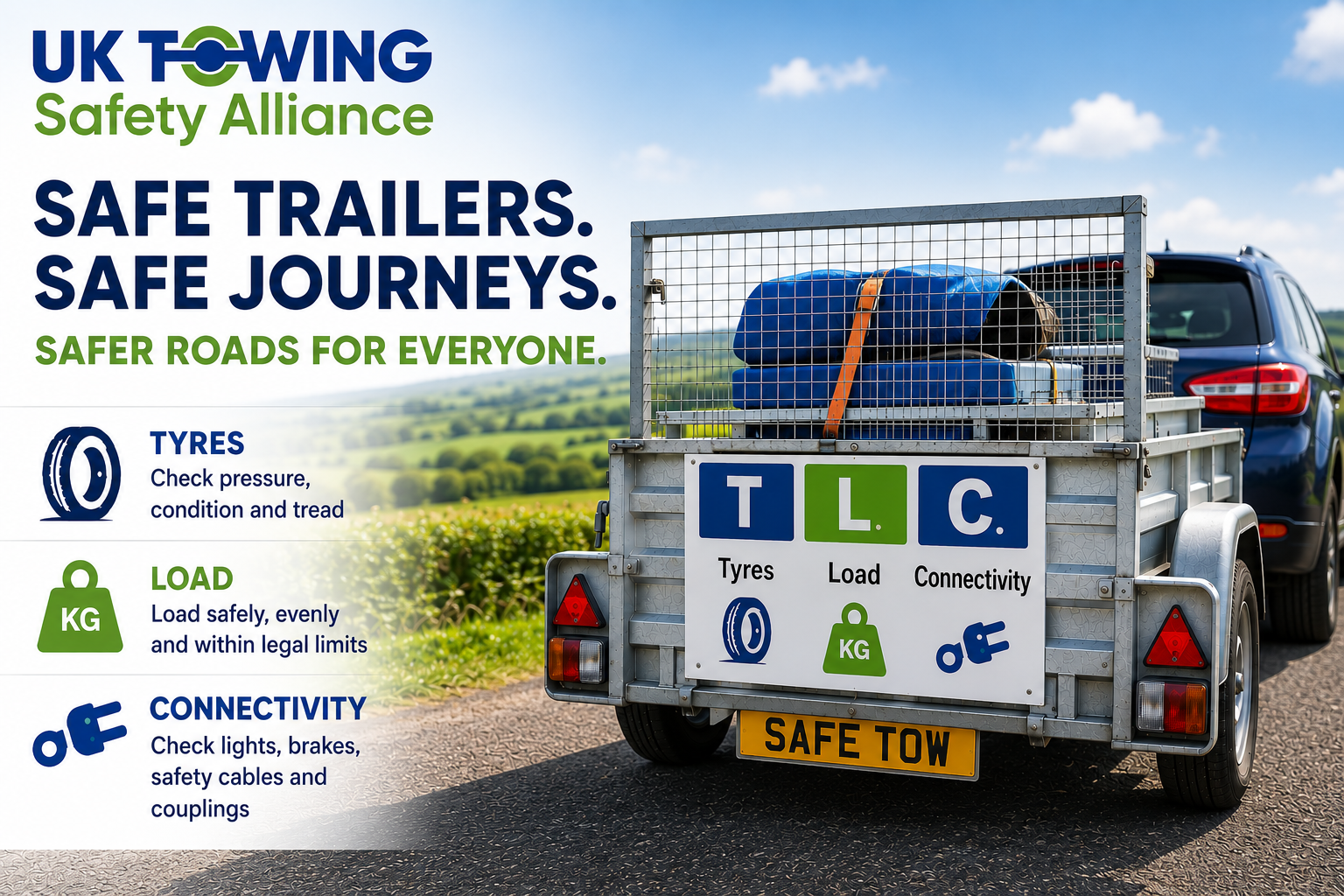
Safe Towing Takes T.L.C.
The UKTSA is urging everyone towing a trailer—whether for business or leisure—to carry out three simple checks before every journey.
Tyres
Check tyre pressures, tread depth and overall condition on both the tow vehicle and trailer. Look for cracks, bulges or signs of age-related deterioration, particularly on trailers that may spend long periods in storage.
Pay particular attention to trailers returning to service after winter or extended periods of inactivity. Check for flat spots, sidewall cracking, perishing and signs of age-related deterioration, even where tread depth appears adequate.
Load
Ensure the trailer is loaded correctly, within its maximum authorised mass, with the load evenly distributed and securely restrained to minimise the risk of instability.
Connection
Check that the coupling is correctly attached, the breakaway cable is fitted properly and all lights and electrical connections are working before setting off.
With agricultural activity, construction projects and seasonal outdoor work all increasing during the summer months, the Alliance is encouraging operators of working trailers to adopt routine maintenance checks before every journey. Improving the condition of trailers used on rural roads will not only reduce preventable breakdowns but also help improve safety for all road users during one of the busiest periods of the year.
Looking Ahead
In response to these findings, the UK Towing Safety Alliance will place “The Working Trailer” at the centre of its safety campaigns.
Working with builders’ merchants, agricultural suppliers, trailer manufacturers, hire companies and industry partners, the Alliance aims to improve maintenance awareness across the utility trailer sector and encourage more routine servicing and inspection.
The Alliance believes that by applying the same maintenance discipline already evident within many leisure sectors, it is possible to reduce preventable breakdowns, improve safety and minimise disruption across the Strategic Road Network.