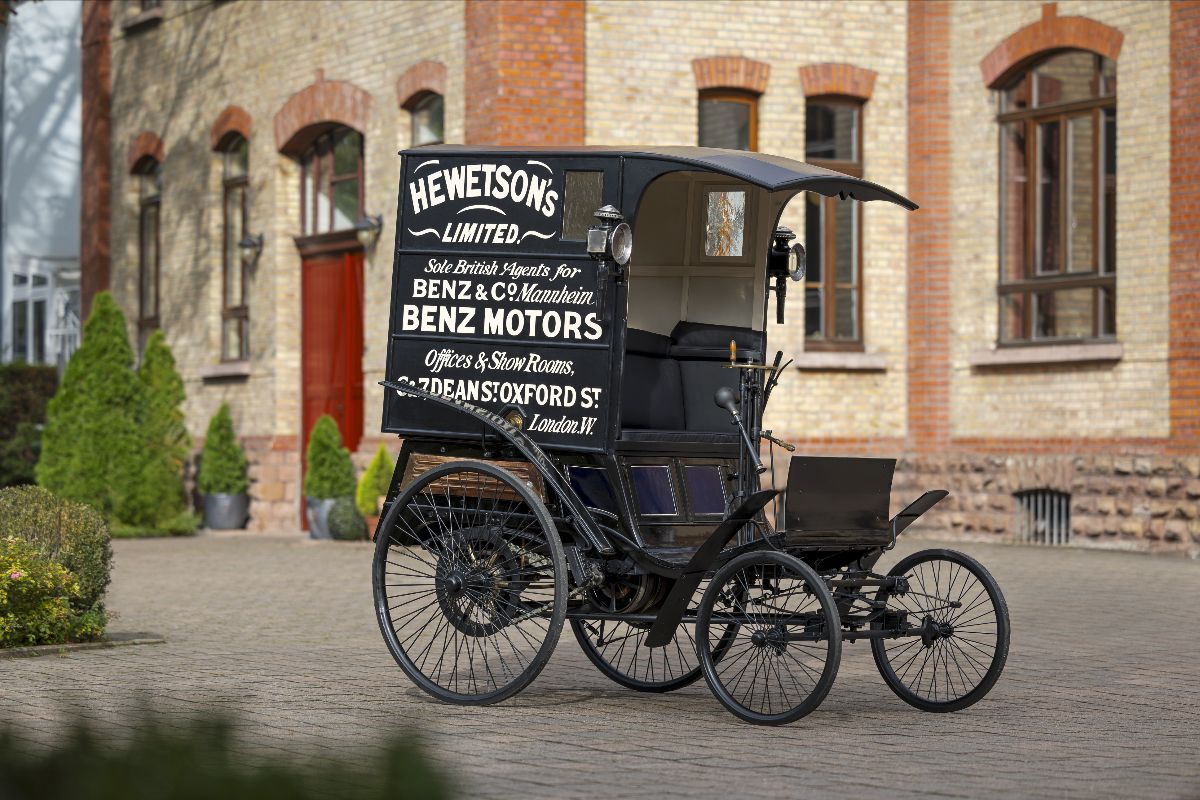
Benz combination delivery vehicle to celebrate 130 years of Mercedes-Benz commercial vehicles on Britain’s roads
An extraordinary piece of automotive history will take to the road this week when Mercedes-Benz’s oldest roadworthy commercial vehicle participates in the RM Sotheby’s London to Brighton Veteran Car Run on Sunday 1 November.
The eye-catching trend-setter will also turn heads at the St James’s Motoring Spectacle – the free-to-attend curtain-raiser on Pall Mall in central London on the previous day, Saturday 31 October.
The 1899 Benz combination delivery vehicle – an exceptionally rare example from the earliest days of commercial motoring – will make the journey from London to Brighton to mark the 130th anniversary of the invention of the motorised transporter by Carl Benz in 1896. Moreover, this year’s capital-to-coast celebration is also honouring the 140th anniversary of Benz’s life-changing Patent-Motorwagen, widely recognised as the world’s very first production car.
Carl Benz’s success story with commercial vehicles began in 1896 when the visionary inventor developed two motorised transporters to meet different customer requirements. The Benz delivery van was conceived as a ‘carriage with an enclosed body’, based on the Benz Victoria, while the smaller Benz combination delivery vehicle was derived from the lighter Benz Velociped.
The latter was an ingenious early multi-purpose vehicle. Its body could be removed in just a few simple steps, transforming the commercial vehicle into a two-seat passenger car. It was an early demonstration of the versatility that would become a defining characteristic of commercial vehicles.
Both models were powered by rear-mounted, single-cylinder four-stroke engines. The larger delivery van used a 2.7-litre engine, while the combination delivery vehicle was equipped with a 1.0-litre unit.
With power outputs ranging from 2.75 to 6hp, the vehicles could reach between 15 and 20km/h when fully loaded. Their payload capacity of up to 300kg, plus the driver, made them highly practical for inner-city transportation – while their performance meant they could travel faster than a two-horse carriage and carry around three times as much cargo.
The first Benz delivery van was handed over to the Du Bon Marché department store in Paris on 5 December 1896, at a purchase price of 4,500 marks. In doing so, Benz & Cie. effectively created an entirely new market within the still-young automobile industry.
The pioneering commercial vehicle coming to London – now part of the Mercedes-Benz Classic collection – represents the origins of the modern Mercedes-Benz van and is one of the earliest examples of a vehicle designed specifically to transport goods by road. Using a Benz Velo from the Mercedes-Benz collection as its basis, Mercedes’ craftsmen meticulously reconstructed the vehicle’s body.
It now returns to the road for the 2026 London to Brighton Veteran Car Run to commemorate this remarkable 130th anniversary of the first Mercedes transporter. More than a century after it first appeared, the diminutive Ideal Van will now demonstrate its pioneering abilities on one of the most celebrated routes in motoring history.
Reinforcing the British connection, the vehicle taking part is an 1899 Benz combination delivery vehicle built under licence in England by London-based Hewetson’s Ltd., the official Benz representative in the UK. Known as the Ideal Van, it is powered by a 3hp engine and was originally capable of carrying around 100kg of goods in addition to its driver. Later versions developed 3.5hp and could accommodate payloads of up to 250kg.
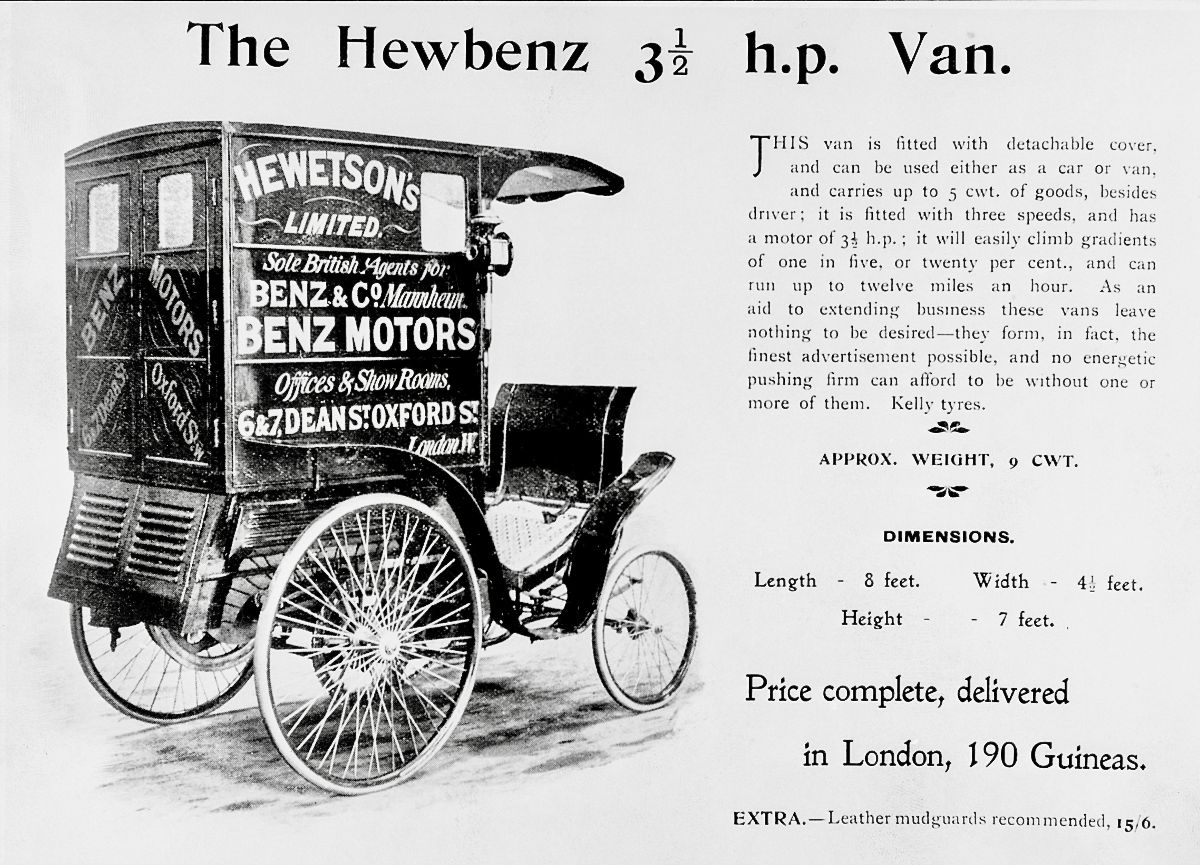
Its participation in the world’s longest-running motoring event will also provide a fascinating reminder of how rapidly the automobile evolved during its formative years, when manufacturers were developing vehicles for an increasingly diverse range of uses.
“Cars such as this remarkable Benz combination delivery vehicle provide a wonderful connection with the very earliest days of motoring and demonstrate just how quickly the pioneers recognised the potential of the motor car beyond simply carrying passengers,” said Duncan Wiltshire, Chairman of the Royal Automobile Club. “To see this extraordinary commercial vehicle take to the historic road from London to Brighton, more than 125 years after it was built, will be a particularly fitting way of celebrating the pioneering spirit that lies at the heart of both the Emancipation Run and the development of the motor vehicle.”
The 2026 RM Sotheby’s London to Brighton Veteran Car Run commemorates the 130th anniversary of the historic Emancipation Run of 1896, which celebrated the passing into law of the Locomotives on Highways Act. The legislation effectively ended the restrictive 4mph speed limit for early motor cars and helped pave the way for the development of motoring in Britain.
The event traditionally sees hundreds of veteran cars – built before 1905 – assemble in central London before setting off on the 60-mile journey to the Sussex coast. For the 1899 Benz combination delivery vehicle, the occasion will provide a uniquely appropriate setting: a pioneering commercial vehicle returning to the roads more than 125 years after it helped demonstrate the practical possibilities of the motor car.
The participation of the oldest roadworthy Mercedes-Benz transporter will also highlight the extraordinary continuity between the pioneering work of Carl Benz and the modern Mercedes-Benz Vans that are an everyday presence on Britain’s roads.
From a tiny 3hp vehicle capable of carrying little more than 100kg to today’s sophisticated commercial vehicles, the fundamental principle remains unchanged – developing innovative and versatile vehicles to transport people and goods efficiently.
The 1899 Benz combination delivery vehicle will therefore be among the most historically significant participants in this year’s RM Sotheby’s London to Brighton Veteran Car Run, celebrating both the birth of the commercial vehicle and the remarkable evolution of the brand with the three-pointed star, since the invention of the automobile by Carl Benz.
The RM Sotheby’s London to Brighton Veteran Car Run is the finale of the Royal Automobile Club’s London Motor Week, which features The Club’s Motoring Book Awards, the Art of Motoring exhibition and the St James’s Motoring Spectacle, a free-to-attend event on Pall Mall in central London. It concludes with the RM Sotheby’s London Sale taking place on Saturday 31 October at the prestigious Peninsula Hotel and the RM Sotheby’s London to Brighton Veteran Car Run.
About RM Sotheby’s London to Brighton Veteran Car Run
With its unique atmosphere and camaraderie, the RM Sotheby’s Veteran Car Run from London to Brighton commemorates the Emancipation Run of 14 November 1896, which celebrated the Locomotives on the Highway Act. The Act raised the speed limit for ‘light locomotives’ from 4 to 14 mph and abolished the need for these vehicles to be preceded by a man on foot waving a red flag.
The first commemoration of the Emancipation Run was held in 1897 with a drive to Sheen House in Richmond Park. Then, in 1927, the inaugural re-enactment followed the original Brighton route and has taken place every November since, apart from the war years and 1947 when petrol was rationed and 2020 during the global Covid-19 pandemic. The Royal Automobile Club manages the Run, which celebrates its 130th anniversary in 2026, with the support of the Veteran Car Club of Great Britain.
For more information visit: www.veterancarrun.com
About the Royal Automobile Club
The Royal Automobile Club was founded in 1897 and its distinguished history mirrors that of motoring itself. In 1907, the Club was awarded its Royal title by King Edward VII, sealing the Club’s status as Britain’s oldest and most influential motoring organisation.
The Club’s early years were focused on promoting the motor car and its place in society, which developed into motoring events such as the 1000 Mile Trial, first held in 1900. In 1905, the Club held the first Tourist Trophy, which remains one of the world’s oldest motor sport events. The Club promoted the first pre-war and post-war Grands Prix at Brooklands in 1926 and Silverstone in 1948 respectively, whilst continuing to campaign for the rights of the motorist, including introducing the first driving licences.
Today, the Club continues to develop and support automobilism through representation on the Fédération Internationale de l’Automobile (FIA) and the RAC Foundation as well as working closely with Motorsport UK. It also promotes its own portfolio of motoring events including the award-winning Royal Automobile Club Concours at Woodcote Park and London Motor Week which concludes with the St James’s Motoring Spectacle on Pall Mall and the RM Sotheby’s London to Brighton Veteran Car Run. The Club also awards a series of internationally recognised trophies and medals celebrating motoring achievements – notable among these are the Segrave Trophy, the Torrens Trophy, the Simms Medal and the Dewar Trophy.
About RM Sotheby’s
RM Sotheby’s is the world’s largest collector car auction house by total sales. With over 45 years of proven results in the collector car industry, RM’s vertically integrated range of services, from auctions (live and online) and private sales to estate planning and financial services, coupled with an expert team of Car Specialists and an international footprint, provide an unsurpassed level of service to the global collector car market. RM Sotheby’s is currently responsible for six of the top ten most valuable motor cars ever sold at auction.
For more information visit: rmsothebys.com