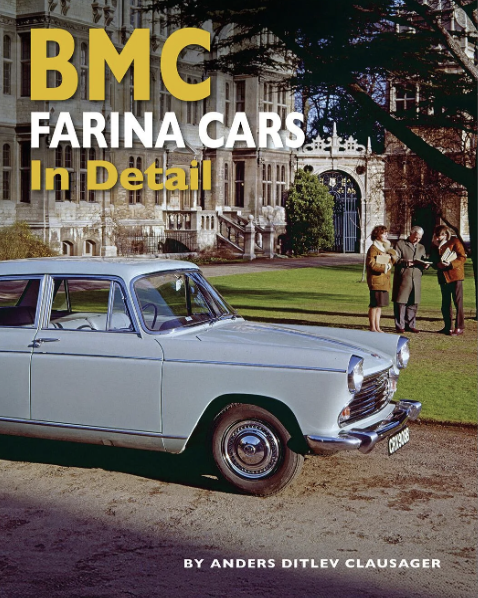
BMC Farina Cars In Detail – Book Review
Reviewed by Kim Henson
Author: Anders Ditlev Clausager
Published by: Herridge & Sons Ltd.
https://www.herridgeandsons.com/
192 pages (hardback), large format (270 x 210mm), and including 360 illustrations
UK Price: £45 (but currently on offer from the publishers at £32.50, with free shipping on all UK orders)
ISBN: 978-1-914929-15-1
It is surprising to me that, with the exception of workshop manuals and other technical literature, this is the first comprehensive book ever to look closely at all the BMC (British Motor Corporation) ‘Farina-styled’ models – in this case collectively covering all variants.
These include the 948cc and 1098cc A40 Farinas (1958 to 1967), and the mid-range 1489cc and 1622cc ‘family’ models (Austins A55 and A60, Morris Oxfords Series V and VI, MG Magnettes Mark III and IV, Rileys 4/68 and 4/72 and Wolseleys 15/60 and 16/60) variously produced between 1958 and 1971.
Covered too are the larger, six cylinder 2912cc Austins A99 and A110 Westminsters and the Wolseleys 6/99 and 6/110, plus the luxurious Vanden Plas versions – as well the closely-related Rolls-Royce powered ‘4 Litre R’.
These large six cylinder models were built between 1959 and 1968.
Renowned, well-respected and multi-award winning motoring writer Anders Ditlev Clausager took on this mighty task (having previously written many fascinating automotive books), and sadly this was to be the last of his works, as he passed away before this book was published.
Before I give my own view on this publication, I should declare an interest, to the extent that since 1962 my own family has owned various examples of BMC ‘Farina’ models, and I grew up travelling in, driving and working on these cars. In fact I still own, drive and maintain examples today (as well as previous Austin forerunners of the Farina-styled cars).
This book covers in-depth the story of how Pinin Farina came to be involved with BMC to bring a fresh look to the Corporation’s range, and delves deeply into the background to each of the various models, explaining how and why they were introduced. It also looks at the development behind them, plus their production history, and includes giving a flavour of the characters of the vehicles in relation to competitors of their time.
In his text the author did not hold back in terms of constructively criticising a few aspects of these widely liked/much-loved cars, but freely acknowledged that for many buyers they were and remain solid, safe, reliable bets, and they are well-loved classics today.
After an introduction to the ‘Farinas’ by way of descriptions of their forerunners in the BMC line-ups of the 1950s, the book includes comprehensive chapters covering each of the freshly-styled Farina models that were produced from 1958.
I found that in each case the well-illustrated text was engaging, informative and very accurate, also sometimes containing information about the cars of which I was previously unaware – all very welcome to this enthusiast and I am sure to others too.
The author’s research had evidently been deep and almost certainly time-consuming, to bring together so much good information plus the many fascinating facts and figures included within its pages. Original factory documents and other contemporary sources were used in the preparation of this book.
One aspect that I especially like about the book are the many comparative tables, showing, for example, details of the cars’ power, performance and contemporary prices, and including competitor models from other manufacturers of the 1950s/60s. These tables all help to build a picture in the minds of readers who may be new to the cars, but equally are of interest also to those who are already devotees.
Each of the models, including the BMC ‘A’ Series powered A40s, the 1.5/1.6 litre ‘B’ Series engined A55s/A60s (and equivalent Morris and other variants) and the larger ‘C’ Series motor cars, plus the Vanden Plas 4 Litre R, is described in great detail. In each case there are full descriptions of the technical aspects of the car, the interior treatment and luggage compartment arrangements.
Variations on the Farina theme are covered too, and perhaps surprisingly (at first glance) is a separate section on ‘banger’ racing, in which the mid-range and large Farina models became favourites for their inherent strength and reliability. In his text the author pointed out that many people who drove these models in banger racing in the 1980s and 1990s are now restoring and looking after surviving examples, these days enjoying them as well-respected and much-loved family classics.
A hugely important part of the book takes the form of a series of very detailed and useful appendices, covering identification and dating, colour schemes, a summary of technical data, production figures and owners’ clubs. It is clear that all these pages have been carefully researched and I know from my own experience in writing automotive books on other classic cars, these must have taken the author an extremely long time to unearth, check and collate all this information.
VERDICT
Excellent; a top class book, packed with information. It covers the ‘Farinas’ in a detailed way and acknowledges their many virtues and how they are loved by many classic car enthusiasts today, as well as by owners in the past. Yet it appraises them honestly and does not look at them through rose-tinted glasses.
A wonderful volume and a fitting legacy for the late Anders Ditlev Clausager as the last book he was able to produce.
If you own, or are interested in, any of the ‘Farina’ models, this book should be on your bookshelf.
Kim Henson, February 2026.