Kim offers a brief general (and personal) perspective on keeping problems at bay, in the hope that this information may help others.
All words and photographs © Kim Henson.
VITAL NOTES:
Observe all safety precautions, including supporting the vehicle on sturdy axle stands, not just jacks, when working on it.
If in any doubt about any aspect of working on the brake system, seek help from competent/professional people.
Recently I was called upon to investigate an unexpected difficulty with the brakes on a classic vehicle. In this case the car is an Austin but the general notes that follow apply widely across many classics.
One morning it was found that the brake pedal suddenly felt ‘soft’ or ‘spongey’ in action, indicating air in the system, requiring immediate attention of course, and the system was fully dismantled and closely checked.
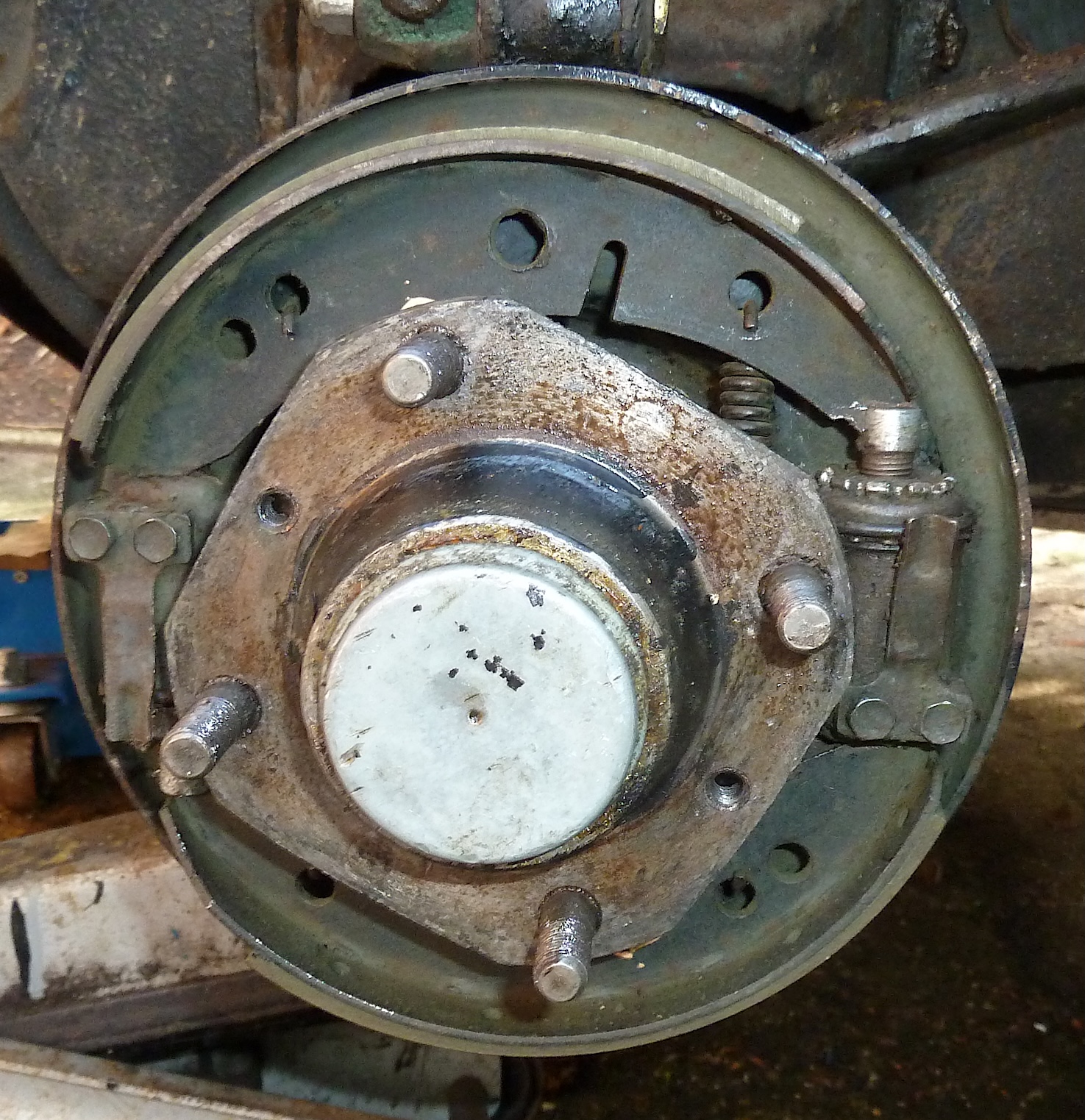
There was no evidence of fluid escaping anywhere in the system, but when it came to stripping down the front brakes, it was found that two of the four pistons were sticking slightly in their hydraulic cylinders, so the pistons were removed and examined, and the cylinder bores were also closely scrutinised.
All the front wheel cylinder metal components appeared to be in excellent condition, so after cleaning up all parts, new rubber seals were fitted to all the pistons (having first soaked the pistons, cylinder bores and new rubber seals in fresh brake fluid), and the newly re-rubbered pistons were inserted into the cylinders from which they had been taken. A little red rubber grease was also applied around the ‘open’ end of each cylinder, to help keep moisture at bay and to keep the pistons moving freely.
IMPORTANT NOTE: New brake seals should only be fitted to hydraulic brake cylinders IF the cylinders are undamaged and with ‘perfect’ bores in terms of wear and condition. Unless this is the case, new cylinders should be installed regardless.
The brake linings appeared to be in good condition so were cleaned with a little brake cleaner liquid (when working on brakes wear a breathing mask and AVOID inhaling any dust, which may contain asbestos) and the brakes were re-assembled and the lining to drum clearance adjusted for all the cylinders, as per the Austin Motor Company’s Workshop Manual.
Surprisingly, a test run revealed that the car was now pulling sharply to the right under braking, so back at base everything was stripped down and examined again, and all looked okay so another test run was undertaken with the same pulling to the right evident. Now this had never happened before with this Austin.
At this point our Wheels-Alive’s ‘Grumpy Old Mechanic’ was consulted (a man with vast and wide experience in the motor trade), and he suggested swapping two of the front brake shoes from side to side, saying that when, some years ago, he was working for a Ford dealership, they had found that the front brakes on an Anglia 105E had been pulling to one side unexpectedly, apparently due to differences in the coefficient of friction between the brake linings on the left and right sides of the vehicle (he added that this can happen even if the brake shoes/linings were taken from a boxed axle set of four). Swapping sides as he suggested resulted in even braking and the Anglia pulling up square, in a straight line.
It was a good idea but on the Austin in question the shoes all looked identical, and with equal wear. Therefore at this point the hydraulics were once more closely examined, no problems were discovered and the brakes were re-assembled. The next test run still resulted in the car pulling sharply to the right under braking.
Now this could have been due to a blocked or restricted flexible brake hose, but it was felt that this was unlikely as fluid seemed to pass easily through the hoses when bleeding air from the system.
Therefore, a set of four brand new brake shoes/linings was fitted, and the car taken for a test run. Result… The car pulled up squarely! So our Grumpy Old Mechanic had been right and a lot of time and effort could have been saved if the brake shoes had been renewed when he had first suggested that the fault might lie in this area.
My thanks to our Grumpy Old Mechanic for his sound advice in this regard and generally with the brake system.
There is much that could be written about the braking systems on classic vehicles, but here are a few general tips that may help you…
CHECK SIMPLE THINGS FIRST…
Always check the simple things first if you have a braking problem. If the car is pulling to one side, and the hydraulics appear to be in good condition, try fitting new brake shoes/linings. This definitely worked in the case of the Austin. I have to confess that we have no idea why the linings on one side of the car worked more efficiently than those on the opposite side!
CLEANLINESS ESSENTIAL
When working on brake systems, and especially the hydraulic components, ensure scrupulous cleanliness.
MAKE SURE THE CYLINDERS AND PISTONS ARE IN EXCELLENT CONDITION
The brake cylinder bores and pistons MUST be unblemished or fluid leaks will occur. If there are any pits, ridges, ‘valleys’ or grooves, fit brand new cylinders.
INSPECT THE FLEXIBLE BRAKE HOSES
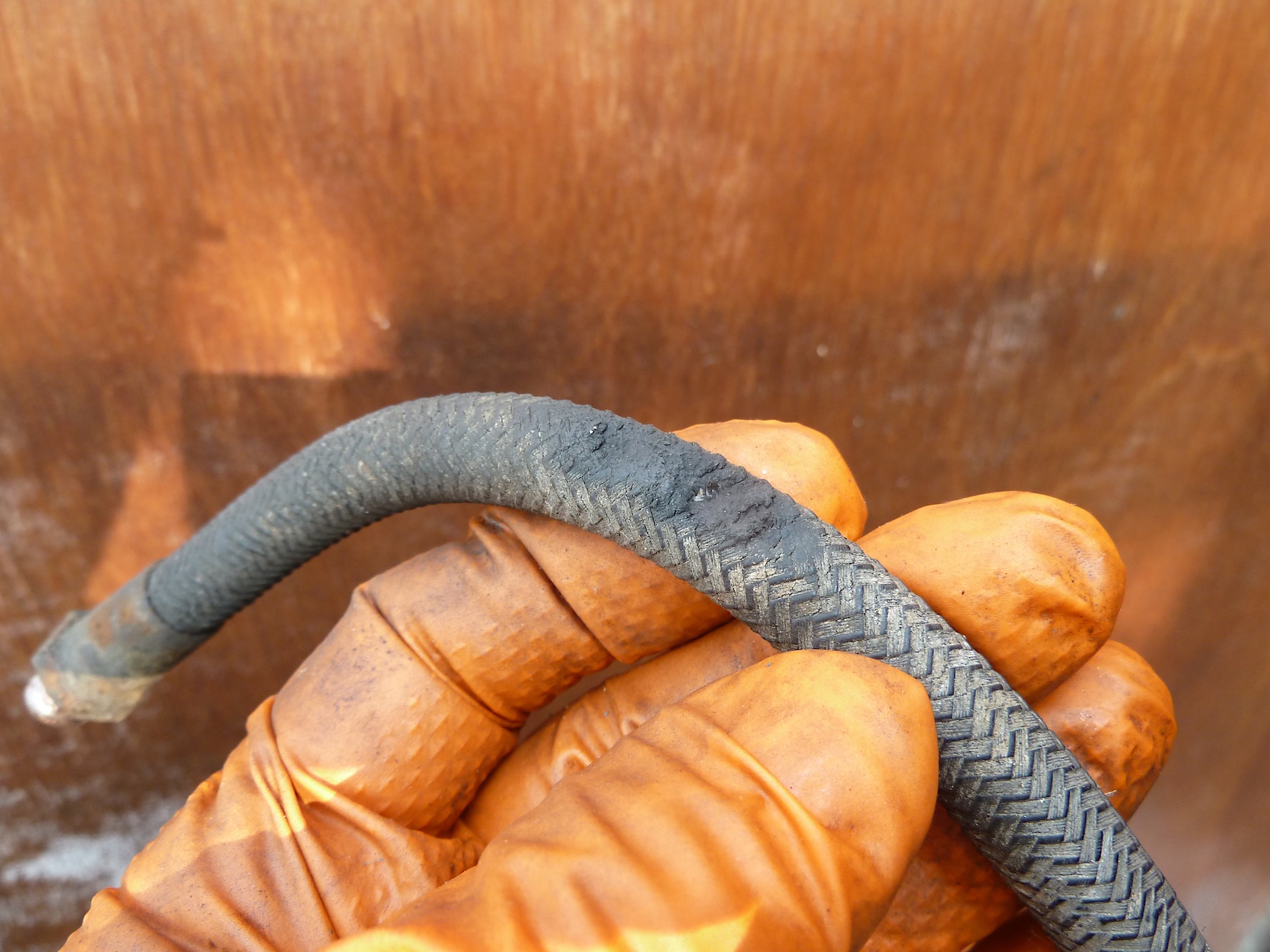 Above: This flexible hose had been chafing on the ‘chassis’, weakening the side wall of the hose. Always check to ensure that the flexible hoses, once fitted, are not in contact with any other components as the steering is turned from lock to lock.
Old hoses can deteriorate in terms of cracking (if you bend the hose trough a fairly tight radius, cracks are more easily spotted) and perishing, visible from the outside.
Less easy to diagnose is collapse or disintegration of the hose within, but symptoms can include pulling to one side under braking, and/or the brakes ‘grabbing’ and staying locked on when the pedal is released; in this case the brakes may free up after leaving the car for a while, as fluid dribbles back through the restricted hose.
Check too for evidence of the hoses chafing on bodywork or moving components (turning the steering on full lock in each direction), and when fitting new hoses, ensure that the hoses, when fully tightened on their mountings, do not touch the wheels, tyres or other components as the steering is turned fully from lock to lock and back again…
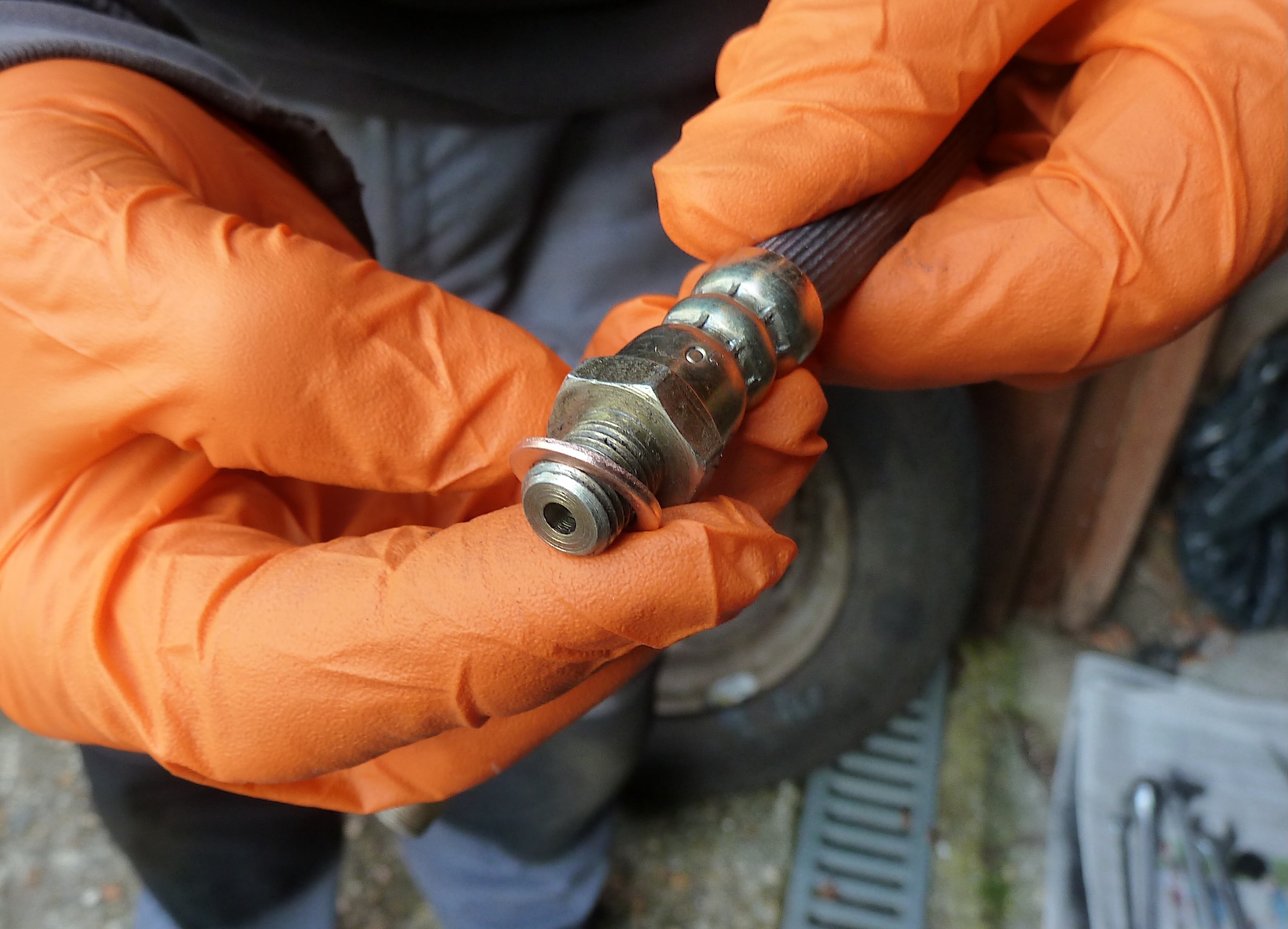
Above: When installing new brake hoses, fit new a new copper sealing washer to the cylinder end of each hose. For many classics these are 3/8in or 10mm diameter, and widely available (the original washer is useful as a guide).
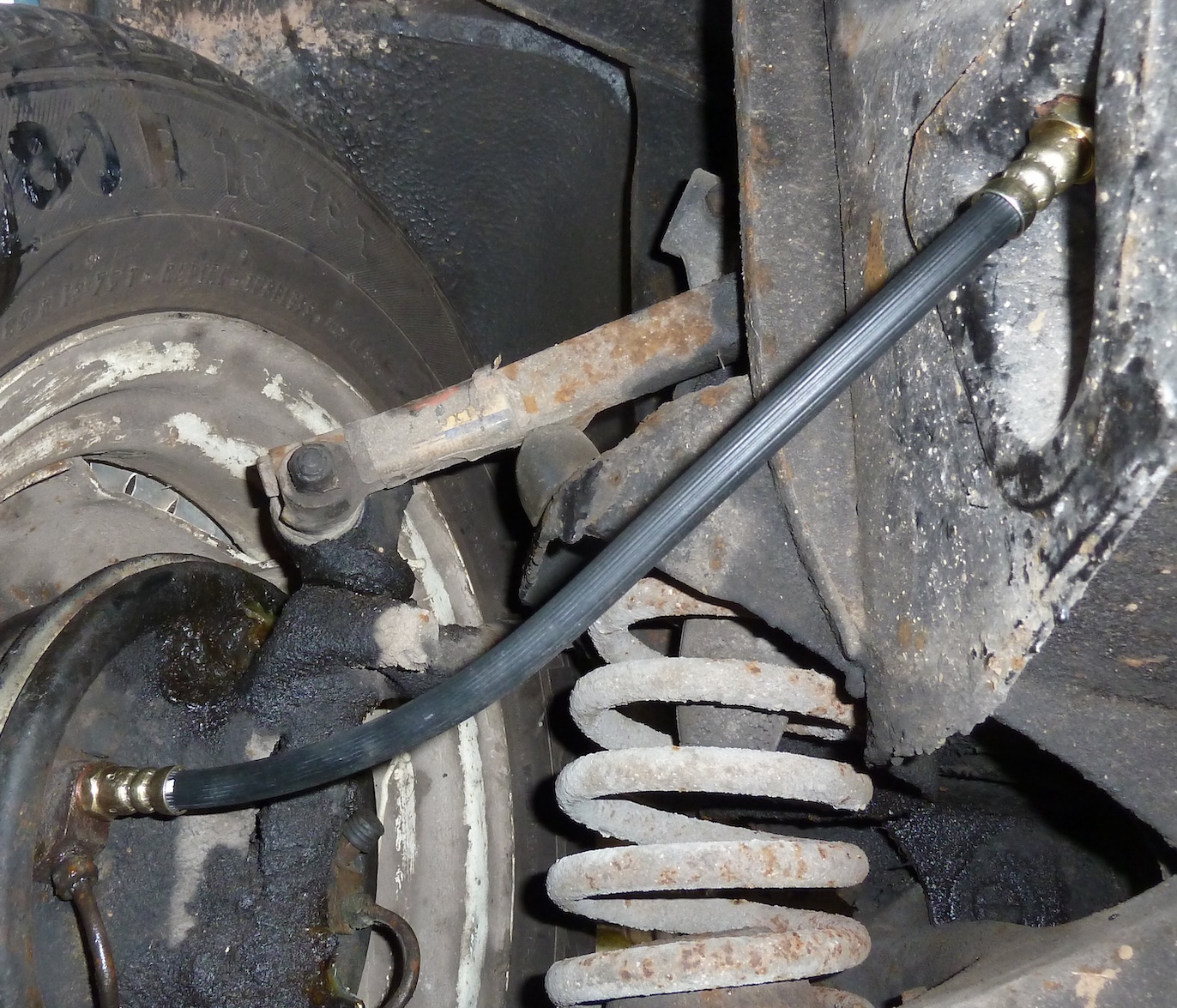
Above: This is how a new brake hose should look as fitted to the vehicle, with a smooth run, no tight curves and away from all other components.
MINIMISE FLUID LOSS
To minimise hydraulic fluid loss when working on the brake system, ideally DO NOT clamp the flexible brake hoses (especially if the hoses are getting on a bit in age), as this crushes the hose and may hasten internal breakdown within the hose. Instead, I advocate filling the master cylinder reservoir with fluid to the top of the filler neck, then applying a small sheet of plastic over the filler neck, holding this in place with the reservoir’s filler cap. In effect this results in a ‘vacuum’ and prevents the fluid from disappearing in quantity when you dismantle parts of the hydraulic system.
On completion of the job, bleed the brakes in the normal way, having removed your sheet of plastic. The fluid level will drop as the brakes are bled of air, and of course it is essential to check the fluid level on completion, and top up if necessary.
USE SILICONE BRAKE FLUID
This is just my personal opinion, but… I have been using silicone brake fluid (produced by Automec) in my classics and some of my modern vehicles, for the past 30 years or so. Silicone fluid is said to provide greater lubricity than standard glycol-based fluid, does not absorb moisture from the atmosphere (so internal corrosion within brake systems is reduced) and does not damage paint. It also lasts a very long time so routine brake fluid changes are not required. I have found it ideal as pistons tend not to seize in their cylinders when using this fluid, even in cars that are out of use for some time (with standard glycol fluid, seizure can occur very easily within brake components on a car unused for a while).
The silicone fluid is not cheap (currently around £50 per litre) but I feel it is superior to glycol fluid, and in any case a litre goes a long way and the fluid also lasts a very long time, compared with glycol types.